




Under the Dome: The Horned King Beneath the Bone
Most rulers build kingdoms.
The Horned King became one.
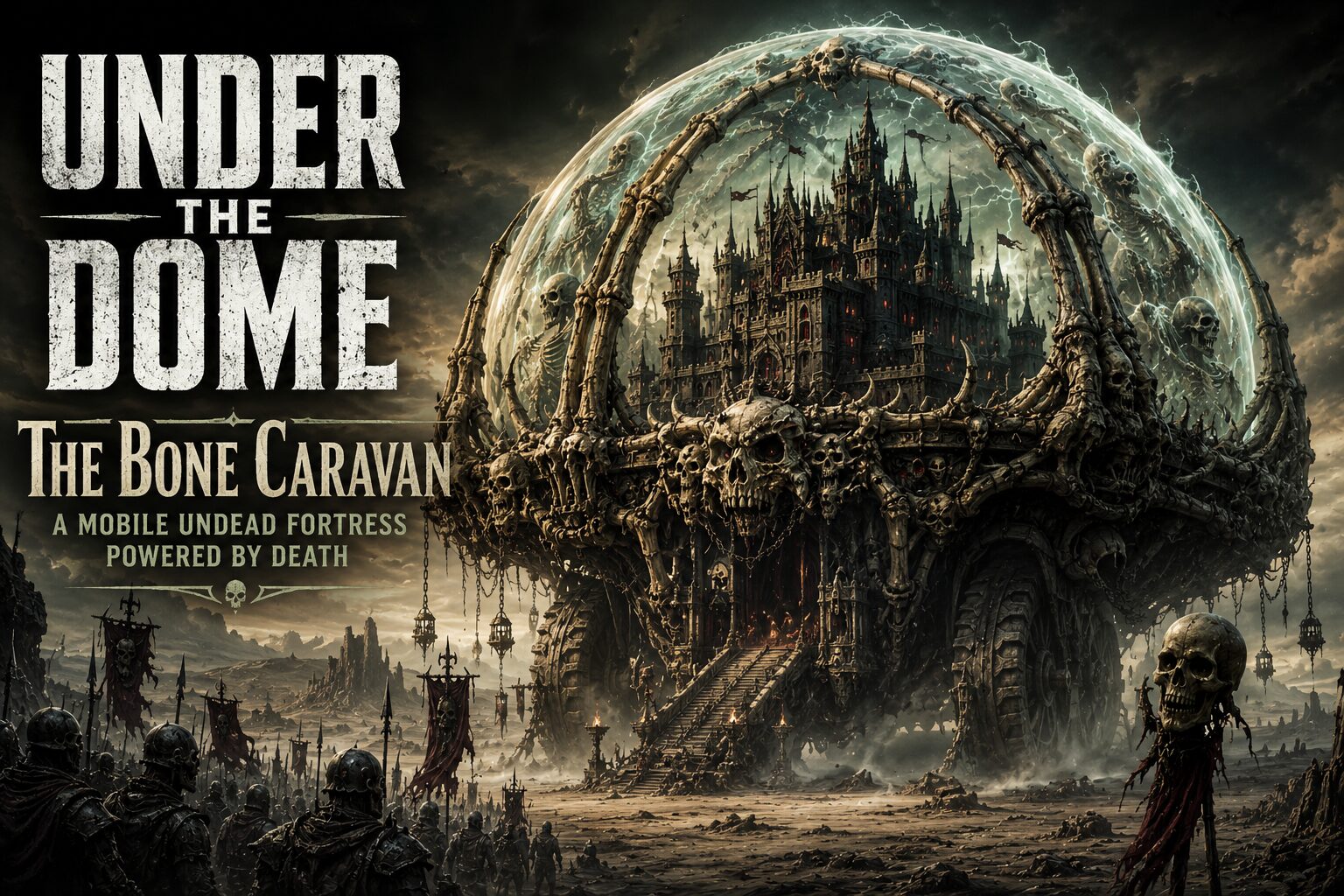
The Bone Caravan is feared across the wastelands for many reasons. It is a mobile fortress large enough to rival smaller Domes. It carries an army that never tires, never hungers, and never questions orders. Entire communities travel within its walls, following its endless march through the chaos-scarred wilderness. Yet for all the terror inspired by the fortress itself, the true source of that fear lies deep beneath its black towers and walls of bone.
At the center of the Bone Caravan sits a ruler unlike anything else in the world.
The Horned King was once a minotaur, though few living souls remember what kind. Some claim he was a warlord before the world ended, a conqueror who united rival clans through strength and strategy. Others insist he was a military commander tasked with protecting entire populations during the first years of the chaos storms. The truth has been buried beneath centuries of myth, but every story reaches the same conclusion.
When civilization collapsed, the Horned King refused to accept death as its inevitable outcome.
Many powerful beings sought immortality during those desperate years. Wizards pursued lichdom, binding their souls to phylacteries in the hope of surviving the apocalypse. Fallen champions became death knights, cursed to continue their existence through hatred, obsession, or unfinished purpose. The Horned King looked upon both paths and found them lacking.
A lich gains eternity but sacrifices connection to the world. A death knight retains purpose but becomes chained to it forever.
The Horned King wanted something else.
He wanted permanence.
Over decades of experimentation, forbidden rituals, and discoveries pulled from the chaos storms themselves, he forged a new form of undeath. He preserved his intellect without retreating into isolation. He retained his martial strength without becoming enslaved to a single curse. Most importantly, he found a way to tie his existence to something larger than himself.
The Bone Caravan is not merely his fortress.
It is part of him.
Travelers who have spent time within the moving city often report strange sensations. The walls seem aware of their presence. Corridors subtly shift to accommodate movement. Entire sections of the fortress react almost like living tissue responding to injury. At first these stories sound like superstition, but those who have studied the Caravan closely suspect something far stranger.
The Horned King’s soul no longer resides entirely within his body.
It has spread throughout the fortress.
The walls, towers, gates, and necromantic machinery of the Bone Caravan are all connected to him in ways no ordinary magic should allow. When one section of the fortress is damaged, repairs often begin before orders can be issued. When intruders enter restricted areas, undead defenders respond with impossible speed. Veterans of campaigns against the Bone Caravan often describe the unsettling feeling that the fortress itself was watching them.
They may be correct.
This connection has allowed the Horned King to create something equally unprecedented within his armies. Most undead are either mindless servants or powerful individuals pursuing their own goals. The Horned King’s creations occupy a space somewhere between those extremes. His Eternal Legion consists of undead soldiers who retain fragments of memory, personality, and skill while remaining completely loyal to the Caravan’s greater purpose.
A former engineer may continue maintaining machinery decades after death. A veteran officer might command troops with the same tactical brilliance that earned them distinction in life. Skilled artisans, scholars, and laborers all continue performing their roles long after their bodies should have failed them.
To outsiders this appears horrifying.
To many inside the Bone Caravan, it appears practical.
That practicality is what makes the Horned King so dangerous.
The wasteland is filled with tyrants, monsters, and would-be conquerors. Most can be understood through familiar motivations such as greed, power, revenge, or madness. The Horned King is different. He genuinely believes he has solved the central problem facing civilization.
He believes humanity itself is the weakness.
In his view, every catastrophe that followed the chaos storms stemmed from the limitations of the living. Hunger creates conflict. Fear creates panic. Grief clouds judgment. Ambition breeds corruption. Mortality ensures that knowledge, experience, and leadership are constantly lost.
The dead suffer from none of these problems.
Within the Bone Caravan, resources are distributed efficiently. Labor is constant. Security is reliable. Entire communities survive conditions that would destroy most settlements. Citizens rarely worry about starvation or raids. The undead standing guard never abandon their posts, and the workers maintaining critical systems never demand rest.
The system works.
That is the terrible truth at the heart of the Horned King’s philosophy.
Many who encounter the Bone Caravan expect to find a kingdom of monsters. Instead they discover a functioning society. Children grow up within its walls. Merchants conduct business. Families build lives beneath the pale glow of the necromantic Dome. The fortress is not a ruin animated by dark magic.
It is a civilization.
And every year it grows.
The chaos storms themselves seem strangely hesitant to challenge it. While other settlements struggle against reality-warping tempests and unpredictable mutations, the Bone Caravan continues its march with unsettling consistency. Scholars argue endlessly over the reason. Some believe the immense concentration of necromantic energy disrupts storm activity. Others suggest the Caravan somehow absorbs fragments of chaos energy and converts them into fuel.
A more disturbing theory has begun circulating among certain researchers.
What if the storms are not avoiding the Horned King?
What if they are changing him?
Every major storm the Bone Caravan survives seems to leave it stronger than before. New sections appear. Existing structures evolve. The undead become more sophisticated. Reports from long-distance observers even suggest that the Horned King himself has grown larger over the centuries, becoming something less like an undead minotaur and more like a force of nature contained within armor and bone.
If those stories are true, then the Horned King’s experiment may no longer be under his control.
Perhaps he did create a new form of undeath.
Perhaps he did discover a path beyond lichdom and death knighthood.
Or perhaps he merely built the first stage of something far larger.
Something that no longer thinks of itself as a ruler.
Something that sees entire cities the way a king sees villages.
Something that is slowly becoming powerful enough to challenge the assumptions upon which every Dome was built.
Because the Horned King no longer asks how civilization can survive.
He asks a far more dangerous question:
What if survival no longer requires the living at all?
Thanks for reading. Until Next Time, Stay Nerdy!!

No Comments